
Have you ever talked to someone (maybe a person you were meeting for the first time, or someone you only knew in passing) and as the conversation got going, alarm bells started ringing in your head?
It wasn’t because they said anything wrong or were being rude. Something just felt off. You couldn’t quite put your finger on it, but you knew there was something inauthentic about the interaction.
That reaction is your authenticity radar. Every single person has one, and it alerts us when someone isn’t being genuine. It’s the same radar that tells us when we’re being treated as an object of utility, or when someone isn’t approaching us with the transparency we try to extend to them.
Without a doubt, this radar comes into play inside our ministries, parishes, and leadership teams. While it’s easy to point out when others fall short, today I want to turn the lens inward and talk about our authenticity as Catholic leaders.
The Pressure of the Calling
Every single one of us has been called into our current season of life and position for a reason. You were plucked from the flock for a higher purpose. As 1 Peter 2:9 reminds us:
“But you are a chosen race, a royal priesthood, a holy nation, a people of his own, so that you may announce the praises of him who called you out of darkness into his wonderful light.”
We have been called to proclaim Christ to others in a deeply unique capacity. But that reality brings pressure. While healthy pressure can help us flourish for His sake, our response to that pressure can easily go off the rails.
When we step into roles where people look to us as spiritual leaders, it creates the perfect environment for two subtle traps: Imposter Syndrome and Main Character Syndrome.
Trap #1: Imposter Syndrome (“I must pretend”)
Imposter syndrome happens when we feel completely inadequate in our position. We feel like we don’t deserve the role. While that might sound like humility on the surface, if we aren’t firmly anchored in our core identity as beloved children of God, it quickly turns into performance.
We feel the need to pretend we have it all together. It focuses entirely on how others perceive us and places an undue weight on our shoulders as we try to control what everyone else thinks.
Imposter syndrome says: “I am not enough, so I must pretend.”
The danger is that the more we feed into this lie, the more vulnerable we become to violating our core values just to fit an image of the “perfect” minister, leader, director, or pastor, an imaginary standard we usually self-impose.
The “I Didn’t Have a Choice” Trap
Think of the movie The Devil Wears Prada. The main character, Andy, steps into the high-pressure world of fashion as an assistant to Miranda Priestly. When Andy starts, she is down-to-earth, loyal, and grounded. But under the constant pressure to “fit in” and please her boss, her values begin to erode.
With every quiet compromise (missing her boyfriend’s birthday, stepping over colleagues, backing out of family events), Andy repeats the exact same phrase: “I didn’t have a choice.”
When Miranda later points out that Andy willingly made those choices, Andy tries to defend herself. But the truth remains: Andy always had a choice.
How often do we as leaders do the exact same thing? We skip family dinners, neglect our personal prayer lives, or compromise our boundaries for the sake of the upcoming retreat, the parish budget, or the event headcount; all while whispering to ourselves, “I didn’t have a choice.”
Trap #2: Main Character Syndrome (“I must control”)
Slowly, performance turns into self-reliance. That is how imposter syndrome transitions straight into Main Character Syndrome.
When we as Catholic leaders start operating as if our ministries, programs, and departments rely solely on our individual performance rather than on the grace of God, our faith goes out the window.
Main character syndrome says: “It all relies on me, so I must control.”
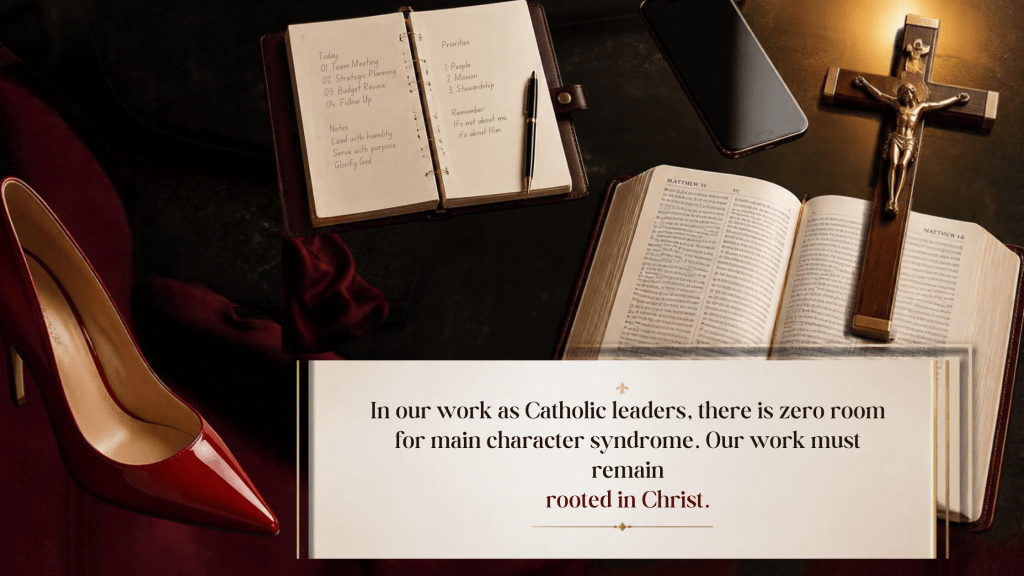
In our work as Catholic leaders, there is zero room for main character syndrome. Our work must remain rooted in Christ. Just as our authenticity radar goes off with others, people pick up on it immediately when leaders fall into this trap. In a world where so much feels counterfeit, people are starving for what is genuine.
The Antidote: Grace Over Grit
Hebrews 8:10 references the Old Testament promise of the New Covenant:
“This is the covenant that I will make with the house of Israel after those days, says the Lord: I will put my laws in their minds, and write them on their hearts, and I will be their God, and they shall be my people.”
God’s law is written on our hearts. Deep down, we usually know when we’re stepping out of alignment with what we profess.
Notice what both imposter syndrome and main character syndrome have in common: they put the entire burden on our shoulders.
The Gospel tells us something completely different. The antidote to pretending and controlling isn’t working harder; it’s resting in God’s grace. Authenticity isn’t about perfection; it’s about letting Christ work through our actual, imperfect selves.
5 Practical Steps to Audit Your Authenticity
So how do we actively guard against these traps and stay authentic? We have to carve out intentional time to sit with the Lord and search our hearts.
Here are five practical reflection steps you can integrate into your prayer life:
- Run a “No Choice” Audit: Start tracking how often you say or think “I didn’t have a choice” or a similar phrase in your work this week. That phrase is almost always the first red flag that your core values are being sacrificed to meet external expectations.
- Define 3 Non-Negotiable Core Values: Write down three personal core values rooted in your identity in Christ. When a project, schedule, or demand forces you to compromise those values, that’s your signal that scope creep or performance culture has taken over.
- Practice a Leader’s Daily Examen: Pray with Psalm 139:23–24: “Search me, O God, and know my heart; test me and know my thoughts. See if there is any wicked way in me, and lead me in the way everlasting.” Use this scripture for a quick three-minute evening review asking two simple questions:
- Where did I act out of fear or performance today?
- Where did I lead out of the overflow of God’s love?
- Lean into Intentional Vulnerability: Authentic leadership requires acknowledging our limits. Saying “I don’t know, but let’s pray and discern this together” builds infinitely more trust than pretending to have every answer.
- Designate an Accountability Partner: Find someone in your life and explicitly give them permission to call you out if they see you slipping into performance or control. Giving them permission in advance breaks down defensive walls so you can listen with openness and humility.
Don’t feel like you need to start all five today. Pick just ONE step that resonated most with where your heart is right now, and bring that single practice into your prayer time this week.
Remember, searching our hearts will look different for everyone. A priest or religious sister may have different time flexibility than those balancing the sacrament of matrimony and family life. There isn’t one “perfect” way to do this; there’s just taking the next right step in your walk with the Lord.
Above all, keep frequenting the Sacraments, especially the Eucharist and Reconciliation. May the Holy Spirit saturate every corner of your leadership and transform everyone you encounter.
Prefer to listen on the go? Check out Episode 4 of the Of Becoming Catholic Leadership Podcast on Spotify. Don’t forget to share this post with a fellow leader!


Leave a Reply